The True Cost of Bad Pallets: Why Late Discovery Gets Expensive Fast
In manufacturing, there’s a lesson most teams learn early:
The later you find a problem, the more expensive it becomes.
A mistake caught in order entry might cost a dollar. The same mistake found after production or delivery can cost hundreds more.
Pallet problems follow the same rule.
The difference with pallets is that failures are often treated as “just part of doing business,” instead of what they really are: an escalating cost issue that gets worse the farther freight travels.
This is how that escalation actually plays out.
Why pallet problems rarely show up on the pallet invoice
When pallet quality is off, the first costs don’t usually show up as a line item.
- Extra labor
- Slower dock flow
- Rework and re-stacking
- Delays that ripple into transportation and delivery
By the time the pallet itself is no longer usable, the real cost has already started stacking up.
The pallet cost curve: how small issues turn into big losses
The pallet doesn’t change.
The cost multiplies based on when the problem is discovered.
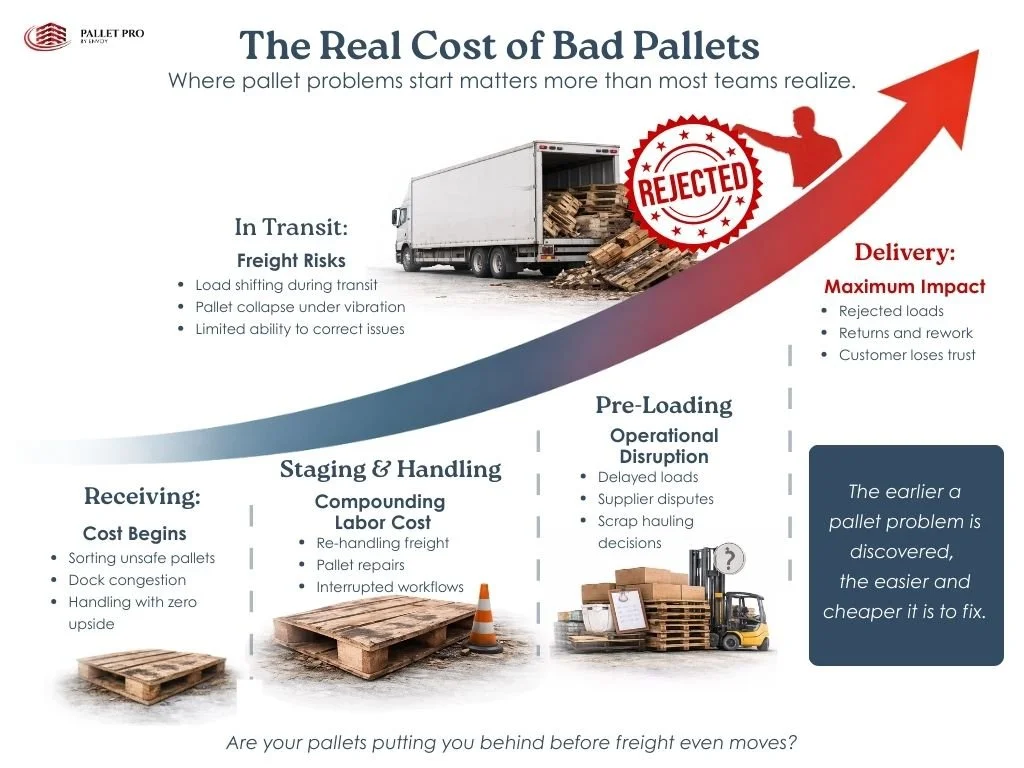
Receiving: Where cost begins
This is the first moment pallet problems surface inside the operation.
- Staff sorting usable pallets from broken ones
- Extra handling to set bad pallets aside
- Slower unloading and dock congestion
The cost here is mostly labor. It’s not catastrophic — but it’s not free.
Staging & Handling: Where labor costs compound
- Deck boards cracking under weight
- Stringers failing after multiple moves
- Loads shifting that shouldn’t
Freight is re-handled, pallets are repaired or rebuilt, and labor is pulled away from productive work.
Pre-Loading: Where decisions get expensive
- Fix pallets or scrap them?
- Is the supplier responsible?
- Who pays to haul scrap away?
Freight waits while decisions are made. Accountability gets blurry. Costs rise quickly.
In Transit: Where control is lost
- Load shifting during transit
- Pallet failures under vibration and movement
- Limited ability to correct issues once moving
At this point, pallet problems become freight risks — and recovery options are limited.
Delivery: Where impact is unavoidable
- Rejected shipments
- Returns, rework, and reshipment
- Lost time and damaged customer trust
The pallet didn’t suddenly fail. The cost multiplied because the problem traveled too far.
Why recycled pallets make this harder
Recycled pallets are widely used for good reason — they’re cost-effective and readily available.
But quality can vary significantly from load to load. Some hold up well. Others fail after minimal handling.
Without consistent inspection or clear standards, variability becomes risk.
What changes when teams pay attention earlier
Most operations don’t overhaul their pallet program overnight.
What usually changes first is awareness.
- Teams flag pallet issues at receiving
- Pallets are matched to load weight and handling methods
- Rework and downstream surprises are reduced
The result isn’t perfect pallets.
It’s fewer failures. Less re-handling. And fewer expensive problems discovered too late.
Final thought
Pallet problems aren’t random. And they’re rarely sudden.
They’re small issues that get expensive because they travel.
Catching them earlier doesn’t just protect pallets. It protects labor, freight, and customer relationships.
If pallets move through your operation regularly, the most cost-effective fix is usually not a cheaper pallet — it’s an earlier checkpoint.
Want a practical way to spot pallet issues earlier?
Download the Pallet Inspection Checklist